


보도 자료 요약
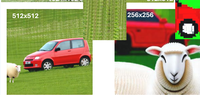
확산 모델은 학습보다 훨씬 낮은 해상도에서 생성할 때 품질이 저하될 수 있습니다. NoiseShift는 예정된 노이즈 수준과 저해상도에서 실제로 느껴지는 손상 수준의 불일치를 원인으로 봅니다. 재학습이나 샘플링 일정 변경 없이 노이즈 조건을 재보정합니다. Stable Diffusion 3, Stable Diffusion 3.5, Flux-Dev에서 추가 추론 비용 없이 개선되었고, LAION-COCO의 128×128 SD3 FID는 203에서 171로 향상되었습니다.
초록
Text-to-image diffusion models often degrade when sampled at resolutions outside the final training resolution set. Prior work has largely emphasized higher resolution generation, enabling pretrained diffusion models to extrapolate beyond the resolutions seen during training. In this work, we instead target lower-resolution generation, performing inference at reduced resolution to significantly cut computational cost. We show that network conditioning of the noise level induces a train-test mismatch that directly degrades low-resolution generation: the same scheduled noise level can correspond to a different perceptual corruption level at lower resolutions, mis-calibrating the denoiser timestep and noise embedding. To this end, we propose NoiseShift, a training-free recalibration method that keeps the original noise sampling schedule unchanged and instead re-indexes the noise conditioning of the denoiser to restore local forward-reverse consistency. Using a lightweight coarse-to-fine calibration on a small set of image-text pairs, NoiseShift learns a resolution-specific mapping from scheduler noise to conditioning noise, reducing train-test mismatch and improving lower-resolution generation quality. When NoiseShift is applied to Stable Diffusion 3 (SD3), Stable Diffusion 3.5 (SD3.5), and Flux-Dev, generation quality at low resolutions improves consistently. Particularly, SD3 generation at 128x128 resolution gets an improved FID score from 203 to 171, and SD3.5 gets an improved FID score from 310 to 277 on LAION-COCO. Even Flux-Dev which already implements a complementary time-shifting strategy gets a modest boost from NoiseShift with an improved FID score from 120 to 113 at 64x64 resolution. More importantly, NoiseShift achieves such improvements with minimal implementation changes and no additional inference overhead.
인용
@article{henoiseshift,
  title = {NoiseShift: Resolution-Aware Noise Recalibration for Better Low-Resolution Image Generation},
  author = {He, Ruozhen and Haji-Ali, Moayed and Yang, Ziyan and Ordonez, Vicente},
  journal = {arXiv preprint arXiv:2510.02307},
  url = {https://arxiv.org/abs/2510.02307},
}
이 논문의 자동 생성된 질문, 주요 기여 및 한계
이 논문이 답하는 데 도움이 되는 질문
- NoiseShift는 무엇을 해결합니까? 최종 학습 해상도보다 낮은 조건의 텍스트-이미지 생성을 개선합니다.
- 왜 품질이 떨어집니까? 같은 예정 노이즈가 저해상도에서는 다른 지각 손상에 해당해 denoiser의 시간 단계와 노이즈 임베딩을 어긋나게 합니다.
- 재학습이 필요합니까? 아니요. 원래 일정을 유지하고 노이즈 조건만 다시 인덱싱합니다.
- 어떤 모델을 평가했습니까? Stable Diffusion 3, Stable Diffusion 3.5, Flux-Dev입니다.
주요 기여
- 해상도 의존적 조건 불일치를 식별합니다.
- 작은 보정 집합으로 해상도별 매핑을 학습합니다.
- 원래 노이즈 일정을 유지하며 보고된 추론 overhead가 없습니다.
- SD3, SD3.5, Flux-Dev의 FID를 개선하며 SD3는 203에서 171이 됩니다.
한계 및 유의 사항
- 세 모델 계열이 중심이며 다른 구조와 도메인은 추가 시험이 필요합니다.
- 작은 보정 집합의 구성이 견고성에 영향을 줄 수 있습니다.
- 사용자 평가, 지연시간, downstream 가치를 함께 측정하면 좋습니다.
- 범위는 좁지만 재학습과 추가 비용이 없다는 점은 실용적입니다.
이 결과를 읽는 방법
NoiseShift는 저해상도의 구체적 불일치를 효율적으로 고치는 방법이며 여러 모델 계열의 일관된 결과가 이를 뒷받침합니다.