

Learning to Reason by Analogy via Retrieval-Augmented Reinforcement Fine-Tuning
보도 자료 요약
검색 증강 모델은 대개 프롬프트와 비슷한 예시를 찾지만, 어려운 문제에는 겉모습이 달라도 같은 풀이 전략을 공유하는 예시가 더 유용할 수 있습니다. RA-RFT는 예상 추론 이득에 따라 데모를 선택하도록 검색기를 학습하고 강화 미세조정에서 그 유추를 사용합니다. 수학 추론에서 표준 강화 미세조정보다 우수하며, AIME 2025 average@32에서 GRPO 대비 Qwen3-1.7B는 7.1점, Qwen3-4B는 2.8점 높았습니다.
초록
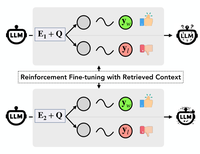
Retrieval-augmented generation (RAG) has become a standard mechanism for grounding language models in external knowledge, yet conventional retrieval based on lexical or semantic similarity is poorly suited for complex reasoning tasks: a semantically similar problem may demand an entirely different solution strategy, while a superficially different problem may share the same underlying reasoning pattern. We propose Retrieval-Augmented Reinforcement Fine-Tuning (RA-RFT), a post-training framework that teaches language models to reason by analogy. RA-RFT uses gold-relevance distillation to train a retriever that ranks contexts by expected reasoning benefit rather than semantic overlap, and then fine-tunes the policy model via reinforcement fine-tuning methods with retrieved analogous demonstrations, so the model learns to leverage reasoning traces under verifiable outcome rewards. We further analyze the diversity of retrieved contexts and find that reasoning-aware retrieval surfaces complementary solution strategies that provide distinct reasoning scaffolds for individual problems. Across challenging mathematical reasoning benchmarks, RA-RFT consistently outperforms standard reinforcement fine-tuning methods. For example, it improves AIME 2025 average@32 accuracy by 7.1 and 2.8 points over GRPO for Qwen3-1.7B and Qwen3-4B respectively -- suggesting that reasoning-aware retrieval is a complementary axis of improvement and orthogonal to advances in reward design or training curricula.
인용
@inproceedings{xiao2026learning,
  title = {Learning to Reason by Analogy via Retrieval-Augmented Reinforcement Fine-Tuning},
  author = {Xiao, Zilin and Ma, Qi and Chen, Chun-cheng Jason and Chen, Xintao and Atreya, Avinash and Chen, Hanjie and Ordonez, Vicente},
  year = {2026},
  booktitle = {Findings of the Conference on Empirical Methods in Natural Language Processing. EMNLP 2026},
  url = {https://arxiv.org/abs/2606.13680},
}
이 논문의 자동 생성된 질문, 주요 기여 및 한계
이 논문이 답하는 데 도움이 되는 질문
- RA-RFT는 무엇입니까? 추론 중심 검색과 강화 미세조정을 결합해 유사한 풀이에서 학습하는 후처리 프레임워크입니다.
- 기존 RAG와 어떻게 다릅니까? 어휘나 의미 유사성보다 대상 추론에 줄 예상 이득으로 문맥을 순위화합니다.
- 검색기는 어떻게 학습합니까? 어떤 데모가 유용한지 알려주는 gold relevance 증류를 사용합니다.
- 결과는 어떻습니까? AIME 2025 average@32에서 GRPO보다 Qwen3-1.7B는 7.1점, Qwen3-4B는 2.8점 높습니다.
주요 기여
- 비슷한 텍스트가 아니라 유사한 풀이 전략을 검색합니다.
- 증류 검색기, 강화 미세조정, 검색 데모, 검증 가능한 보상을 결합합니다.
- 추론 중심 검색이 상호 보완적인 추론 발판을 제공함을 분석합니다.
- 두 Qwen3 크기에서 표준 RFT를 개선합니다.
한계 및 유의 사항
- 평가가 수학 중심이므로 코딩, 과학, 개방형 과제가 다음 단계입니다.
- gold relevance 증류에 의존합니다.
- 검색 비용, 말뭉치 민감도, 노이즈 데모의 영향을 배포 환경에서 측정해야 합니다.
- 모든 과제가 유추에서 같은 이득을 얻지는 않지만 유망한 보완 축임을 보여줍니다.
이 결과를 읽는 방법
RA-RFT는 검색이 정보뿐 아니라 적절한 유추를 제공할 때 추론을 향상시킬 수 있음을 강하게 보여줍니다.