


新闻稿摘要
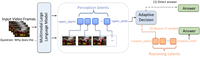
视频问答系统常常生成很长的文字推理链,但有些问题只需定位视频中的关键时刻即可回答。Dynamic Latent Reasoning(DyLaR)用紧凑的潜在状态表示视觉证据,并仅在需要时加入额外的潜在推理,而不是输出冗长文本。系统会学习何时在感知后直接作答、何时继续推理。在九个基准和四种基础模型上,作者报告平均准确率更高且每题生成少于20个token;在Qwen3-VL-4B上,平均准确率从54.0提升到58.2,平均回答长度从1,220.7降至18.5个token。
摘要
Video question answering requires models to ground language queries in visual evidence and, when necessary, reason over that evidence across time. Existing methods typically rely on long textual chain-of-thought rationales, even though many questions can be answered as soon as the relevant object, action, or frame is localized. We propose Dynamic Latent Reasoning (DyLaR), which first grounds a question in a short block of perception latents (continuous hidden states that encode query-relevant visual evidence), and then adaptively decides whether to append reasoning latents (continuous thoughts that reason over this evidence in latent space) before answering. DyLaR learns this behavior by grounding perception latents in verified visual evidence and distilling verified rationales into reasoning latents, followed by reinforcement learning that further refines when to reason. Across nine video benchmarks and four multimodal language model backbones, DyLaR improves average accuracy over same-backbone baselines while generating fewer than 20 tokens per query. On Qwen3-VL-4B, for example, DyLaR improves average accuracy over Qwen3-VL-4B-Thinking from 54.0 to 58.2 while reducing response length from 1,220.7 to 18.5 tokens per query. Ablations further show that grounded perception latents, rationale-supervised reasoning latents, and adaptive routing each improve accuracy.
引用
@article{xiaperception,
  title = {Perception Before Reasoning: Dynamic Latent Reasoning for Video Understanding and Question Answering},
  author = {Xia, Haotian and Xiao, Zilin and Zou, Junbo and Ordonez, Vicente and Chen, Hanjie},
  journal = {arXiv preprint arXiv:2608.04124},
  url = {https://arxiv.org/abs/2608.04124},
}
自动生成的本文相关问题、主要贡献与局限
本文有助于回答的问题
- DyLaR解决什么问题?它先将问题落到紧凑的视觉证据潜变量中,仅在必要时添加潜在推理,从而减少冗长的文字推理链。
- DyLaR如何决定是否继续推理?学习到的自适应路由会选择在感知后直接回答,或在回答前加入潜在推理。
- 训练使用哪些监督?方法以已验证的视觉证据监督感知潜变量,将已验证的推理过程蒸馏到推理潜变量中,再用强化学习优化路由。
- DyLaR取得了什么结果?在九个视频基准和四种基础模型上,它以少于20个输出token提高平均准确率;Qwen3-VL-4B从54.0提升到58.2。
主要贡献
- DyLaR将与问题相关的视觉感知和可选潜在推理解耦,使不同问题使用不同计算量。
- 训练方案结合视觉证据监督、推理过程蒸馏和用于自适应路由的强化学习。
- 消融实验表明,感知潜变量、推理潜变量和自适应路由均带来增益。
- 评测覆盖九个视频基准和四种多模态基础模型。
局限与注意事项
- 当前评测集中于视频问答,其他多模态任务仍需验证。
- 训练依赖已验证的视觉证据和推理过程,扩展到新视频领域时需要研究其可扩展性。
- 效率主要以输出长度衡量,未来还可测量延迟、内存和视觉计算量。
- 结果来自基准测试,但跨多种基础模型的一致提升为潜在路由提供了积极证据。
如何理解这一结果
DyLaR可视为一种证据充分的选择性视频推理方法,基准结果扎实,其效率优势值得在更广泛的实际场景中继续验证。