


보도 자료 요약
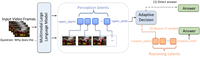
비디오 질의응답 시스템은 올바른 장면만 찾으면 되는 경우에도 긴 텍스트 추론을 생성하곤 합니다. Dynamic Latent Reasoning(DyLaR)은 시각적 근거와 필요한 추가 추론을 긴 문장 대신 압축된 잠재 상태로 표현합니다. 시스템은 지각 후 바로 답할지, 추론을 더할지 학습합니다. 9개 벤치마크와 4개 기반 모델에서 질문당 20 token 미만으로 평균 정확도를 높였고, Qwen3-VL-4B에서는 정확도가 54.0에서 58.2로 상승하면서 평균 응답 길이는 1,220.7에서 18.5 token으로 줄었습니다.
초록
Video question answering requires models to ground language queries in visual evidence and, when necessary, reason over that evidence across time. Existing methods typically rely on long textual chain-of-thought rationales, even though many questions can be answered as soon as the relevant object, action, or frame is localized. We propose Dynamic Latent Reasoning (DyLaR), which first grounds a question in a short block of perception latents (continuous hidden states that encode query-relevant visual evidence), and then adaptively decides whether to append reasoning latents (continuous thoughts that reason over this evidence in latent space) before answering. DyLaR learns this behavior by grounding perception latents in verified visual evidence and distilling verified rationales into reasoning latents, followed by reinforcement learning that further refines when to reason. Across nine video benchmarks and four multimodal language model backbones, DyLaR improves average accuracy over same-backbone baselines while generating fewer than 20 tokens per query. On Qwen3-VL-4B, for example, DyLaR improves average accuracy over Qwen3-VL-4B-Thinking from 54.0 to 58.2 while reducing response length from 1,220.7 to 18.5 tokens per query. Ablations further show that grounded perception latents, rationale-supervised reasoning latents, and adaptive routing each improve accuracy.
인용
@article{xiaperception,
  title = {Perception Before Reasoning: Dynamic Latent Reasoning for Video Understanding and Question Answering},
  author = {Xia, Haotian and Xiao, Zilin and Zou, Junbo and Ordonez, Vicente and Chen, Hanjie},
  journal = {arXiv preprint arXiv:2608.04124},
  url = {https://arxiv.org/abs/2608.04124},
}
이 논문의 자동 생성된 질문, 주요 기여 및 한계
이 논문이 답하는 데 도움이 되는 질문
- DyLaR은 어떤 문제를 해결합니까? 질문을 압축된 시각 근거 잠재값에 먼저 연결하고 필요할 때만 잠재 추론을 추가해 긴 텍스트 추론을 줄입니다.
- 추론을 더할지는 어떻게 정합니까? 학습된 적응형 라우팅이 지각 후 답하거나 잠재 추론을 추가하도록 선택합니다.
- 어떤 감독 신호를 사용합니까? 검증된 시각 근거, 검증된 근거 설명에서 증류한 추론 잠재값, 라우팅을 다듬는 강화학습을 사용합니다.
- 결과는 어떻습니까? 9개 벤치마크와 4개 기반 모델에서 20 token 미만으로 정확도를 높였고 Qwen3-VL-4B는 54.0에서 58.2가 되었습니다.
주요 기여
- 관련 시각 지각과 선택적 잠재 추론을 분리해 질문별 계산량을 조절합니다.
- 시각 근거, 검증된 설명, 적응형 라우팅을 위한 강화학습을 결합합니다.
- 절제 실험으로 지각 잠재값, 추론 잠재값, 라우팅의 기여를 보입니다.
- 9개 비디오 벤치마크와 4개 멀티모달 기반 모델에서 평가합니다.
한계 및 유의 사항
- 평가는 비디오 질의응답에 집중하며 다른 멀티모달 과제는 추가 검증이 필요합니다.
- 검증된 근거와 설명을 새 도메인으로 확장하는 방법을 연구할 수 있습니다.
- 출력 길이 외에 지연시간, 메모리, 시각 계산량도 측정할 필요가 있습니다.
- 벤치마크 중심이지만 여러 기반 모델에서 일관된 개선은 긍정적입니다.
이 결과를 읽는 방법
DyLaR은 비디오 질의응답에서 추론을 선택적으로 사용하는 근거가 탄탄한 접근법이며, 강한 벤치마크 결과와 더 넓게 검증할 효율성 가능성을 보여줍니다.