


新闻稿摘要
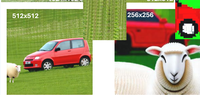
扩散模型在远低于训练分辨率的尺寸上生成图像时往往会退化。NoiseShift将原因定位为计划噪声级别与低分辨率下实际感知到的破坏程度不匹配。该方法无需重新训练模型或修改采样日程,只需重新校准去噪器的噪声条件。在Stable Diffusion 3、Stable Diffusion 3.5和Flux-Dev上,作者报告低分辨率质量持续改善且不增加推理开销;例如,SD3在LAION-COCO上以128×128生成时,FID从203改善到171。
摘要
Text-to-image diffusion models often degrade when sampled at resolutions outside the final training resolution set. Prior work has largely emphasized higher resolution generation, enabling pretrained diffusion models to extrapolate beyond the resolutions seen during training. In this work, we instead target lower-resolution generation, performing inference at reduced resolution to significantly cut computational cost. We show that network conditioning of the noise level induces a train-test mismatch that directly degrades low-resolution generation: the same scheduled noise level can correspond to a different perceptual corruption level at lower resolutions, mis-calibrating the denoiser timestep and noise embedding. To this end, we propose NoiseShift, a training-free recalibration method that keeps the original noise sampling schedule unchanged and instead re-indexes the noise conditioning of the denoiser to restore local forward-reverse consistency. Using a lightweight coarse-to-fine calibration on a small set of image-text pairs, NoiseShift learns a resolution-specific mapping from scheduler noise to conditioning noise, reducing train-test mismatch and improving lower-resolution generation quality. When NoiseShift is applied to Stable Diffusion 3 (SD3), Stable Diffusion 3.5 (SD3.5), and Flux-Dev, generation quality at low resolutions improves consistently. Particularly, SD3 generation at 128x128 resolution gets an improved FID score from 203 to 171, and SD3.5 gets an improved FID score from 310 to 277 on LAION-COCO. Even Flux-Dev which already implements a complementary time-shifting strategy gets a modest boost from NoiseShift with an improved FID score from 120 to 113 at 64x64 resolution. More importantly, NoiseShift achieves such improvements with minimal implementation changes and no additional inference overhead.
引用
@article{henoiseshift,
  title = {NoiseShift: Resolution-Aware Noise Recalibration for Better Low-Resolution Image Generation},
  author = {He, Ruozhen and Haji-Ali, Moayed and Yang, Ziyan and Ordonez, Vicente},
  journal = {arXiv preprint arXiv:2510.02307},
  url = {https://arxiv.org/abs/2510.02307},
}
自动生成的本文相关问题、主要贡献与局限
本文有助于回答的问题
- NoiseShift解决什么问题?它改善扩散模型在低于最终训练分辨率时的文生图质量。
- 低分辨率为何导致质量下降?同一计划噪声在低分辨率下对应不同的感知破坏程度,使去噪器的时间步和噪声嵌入失准。
- 需要重新训练吗?不需要;NoiseShift保留原采样日程,只重新索引噪声条件。
- 测试了哪些模型?Stable Diffusion 3、Stable Diffusion 3.5和Flux-Dev。
主要贡献
- NoiseShift识别出分辨率相关的噪声条件失配。
- 它用少量校准数据学习分辨率特定的噪声映射。
- 方法保留原噪声日程,且不增加已报告的推理开销。
- SD3、SD3.5和Flux-Dev的FID均有改善,包括SD3从203降至171。
局限与注意事项
- 目前只评估了三类扩散模型,其他架构和图像领域仍需测试。
- 小型校准集的构成可能影响跨提示和分辨率的稳健性。
- 用户感知、延迟和下游价值评测可补充现有图像指标。
- 方法范围有意聚焦,但无需重训且无额外推理开销使其具有实用价值。
如何理解这一结果
NoiseShift是针对低分辨率具体失配问题的高效修正,并得到多个常用模型系列上一致结果的支持。