
Learning to Reason by Analogy via Retrieval-Augmented Reinforcement Fine-Tuning
新闻稿摘要
检索增强模型通常寻找与当前提示语义相似的例子,但困难推理题最有帮助的例子可能表面不同、却共享同一种解题策略。RA-RFT训练检索器按预期推理收益选择示例,并在强化微调中利用这些类比。作者发现,面向推理的检索能够提供互补的解题策略,并在数学推理上超过标准强化微调。在AIME 2025上,相比GRPO,Qwen3-1.7B的average@32提高7.1个百分点,Qwen3-4B提高2.8个百分点。
摘要
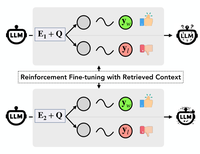
Retrieval-augmented generation (RAG) has become a standard mechanism for grounding language models in external knowledge, yet conventional retrieval based on lexical or semantic similarity is poorly suited for complex reasoning tasks: a semantically similar problem may demand an entirely different solution strategy, while a superficially different problem may share the same underlying reasoning pattern. We propose Retrieval-Augmented Reinforcement Fine-Tuning (RA-RFT), a post-training framework that teaches language models to reason by analogy. RA-RFT uses gold-relevance distillation to train a retriever that ranks contexts by expected reasoning benefit rather than semantic overlap, and then fine-tunes the policy model via reinforcement fine-tuning methods with retrieved analogous demonstrations, so the model learns to leverage reasoning traces under verifiable outcome rewards. We further analyze the diversity of retrieved contexts and find that reasoning-aware retrieval surfaces complementary solution strategies that provide distinct reasoning scaffolds for individual problems. Across challenging mathematical reasoning benchmarks, RA-RFT consistently outperforms standard reinforcement fine-tuning methods. For example, it improves AIME 2025 average@32 accuracy by 7.1 and 2.8 points over GRPO for Qwen3-1.7B and Qwen3-4B respectively -- suggesting that reasoning-aware retrieval is a complementary axis of improvement and orthogonal to advances in reward design or training curricula.
引用
@inproceedings{xiao2026learning,
  title = {Learning to Reason by Analogy via Retrieval-Augmented Reinforcement Fine-Tuning},
  author = {Xiao, Zilin and Ma, Qi and Chen, Chun-cheng Jason and Chen, Xintao and Atreya, Avinash and Chen, Hanjie and Ordonez, Vicente},
  year = {2026},
  booktitle = {Findings of the Conference on Empirical Methods in Natural Language Processing. EMNLP 2026},
  url = {https://arxiv.org/abs/2606.13680},
}
自动生成的本文相关问题、主要贡献与局限
本文有助于回答的问题
- RA-RFT是什么?它是一种后训练框架,将面向推理的检索与强化微调结合,使模型从类比解法中学习。
- 与传统RAG有何不同?它按上下文对目标推理的预期帮助排序,而非主要依赖词汇或语义相似度。
- 检索器如何训练?通过gold相关性蒸馏学习哪些示例真正有助于解题。
- 结果如何?在AIME 2025 average@32上,RA-RFT分别比GRPO高7.1和2.8个百分点。
主要贡献
- RA-RFT把推理检索定义为寻找类比解题策略,而不只是相似文本。
- 它结合蒸馏检索器、强化微调、检索示例和可验证结果奖励。
- 分析表明面向推理的检索能提供互补的推理支架。
- 在Qwen3-1.7B和Qwen3-4B上均优于标准强化微调。
局限与注意事项
- 评测集中于数学推理,编程、科学和开放任务是重要的后续方向。
- 方法依赖gold相关性蒸馏,其监督质量会影响迁移。
- 部署研究还应量化检索成本、语料敏感性和噪声示例的影响。
- 并非所有任务都会同等受益于类比,但结果说明检索选择是有价值的互补方向。
如何理解这一结果
RA-RFT有力说明,检索不仅能补充信息,还能通过提供正确的类比来改善推理。