

Learning to Reason by Analogy via Retrieval-Augmented Reinforcement Fine-Tuning
プレスリリース要約
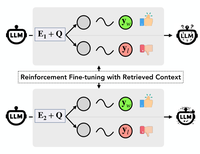
検索拡張モデルは通常、入力に似た例を探しますが、難しい問題には表面的に異なっても同じ解法を持つ例が役立つことがあります。RA-RFTは推論への期待効果でデモを選ぶ検索器を訓練し、その類推を強化微調整で利用します。数学推論で標準的な強化微調整を上回り、AIME 2025のaverage@32ではGRPOよりQwen3-1.7Bで7.1ポイント、Qwen3-4Bで2.8ポイント高い結果です。
要旨
Retrieval-augmented generation (RAG) has become a standard mechanism for grounding language models in external knowledge, yet conventional retrieval based on lexical or semantic similarity is poorly suited for complex reasoning tasks: a semantically similar problem may demand an entirely different solution strategy, while a superficially different problem may share the same underlying reasoning pattern. We propose Retrieval-Augmented Reinforcement Fine-Tuning (RA-RFT), a post-training framework that teaches language models to reason by analogy. RA-RFT uses gold-relevance distillation to train a retriever that ranks contexts by expected reasoning benefit rather than semantic overlap, and then fine-tunes the policy model via reinforcement fine-tuning methods with retrieved analogous demonstrations, so the model learns to leverage reasoning traces under verifiable outcome rewards. We further analyze the diversity of retrieved contexts and find that reasoning-aware retrieval surfaces complementary solution strategies that provide distinct reasoning scaffolds for individual problems. Across challenging mathematical reasoning benchmarks, RA-RFT consistently outperforms standard reinforcement fine-tuning methods. For example, it improves AIME 2025 average@32 accuracy by 7.1 and 2.8 points over GRPO for Qwen3-1.7B and Qwen3-4B respectively -- suggesting that reasoning-aware retrieval is a complementary axis of improvement and orthogonal to advances in reward design or training curricula.
引用
@inproceedings{xiao2026learning,
  title = {Learning to Reason by Analogy via Retrieval-Augmented Reinforcement Fine-Tuning},
  author = {Xiao, Zilin and Ma, Qi and Chen, Chun-cheng Jason and Chen, Xintao and Atreya, Avinash and Chen, Hanjie and Ordonez, Vicente},
  year = {2026},
  booktitle = {Findings of the Conference on Empirical Methods in Natural Language Processing. EMNLP 2026},
  url = {https://arxiv.org/abs/2606.13680},
}
この論文について自動生成された質問、主な貢献、および限界
この論文が答える助けとなる質問
- RA-RFTとは?推論重視の検索と強化微調整を組み合わせ、類似した解法から学ぶ後学習手法です。
- 通常のRAGとの違いは?語彙・意味類似度より、対象推論への期待効果で文脈を順位付けします。
- 検索器はどう訓練しますか?どのデモが有用かを示すgold relevanceの蒸留を使います。
- 結果は?AIME 2025 average@32でGRPOをQwen3-1.7Bでは7.1、Qwen3-4Bでは2.8ポイント上回ります。
主な貢献
- 似た文章ではなく類似した解法戦略を検索します。
- 蒸留検索器、強化微調整、検索デモ、検証可能な報酬を組み合わせます。
- 推論重視検索が相補的な足場を提供することを分析します。
- 2サイズのQwen3で標準RFTを改善します。
限界と注意点
- 評価は数学中心で、コード、科学、自由形式課題は今後の検証対象です。
- gold relevanceの蒸留に依存します。
- 検索コスト、コーパス感度、ノイズのあるデモを配備時に測る必要があります。
- 全課題が同程度に類推の恩恵を受けるとは限りませんが、有望な補完軸を示します。
この結果の読み解き方
RA-RFTは、検索が情報だけでなく適切な類推を与えることで推論を改善できることを強く示しています。