


SoftmaxGRPO: Learning to Reason using Softmax Advantage Group Estimation
News Release Summary
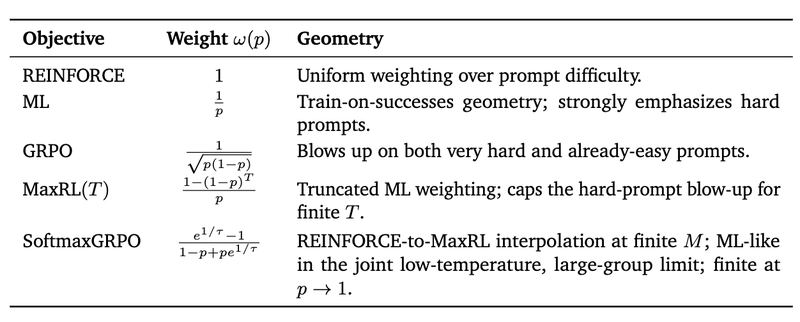
Researchers at Rice University have introduced SoftmaxGRPO, a small but principled change to a widely used reinforcement learning recipe for post-training large language models. The method targets a known weakness in GRPO, the group-based objective that has become standard for teaching models to reason: when rewards are simply right-or-wrong, GRPO's within-group normalization ends up pouring a disproportionate share of the learning signal into prompts the model can already solve, wasting effort where there is little left to learn. This problem is worst in settings without cheap automatic graders, such as summarization or creative writing, where training must rely on weak text-overlap scores. SoftmaxGRPO is a one-line drop-in replacement that swaps GRPO's z-score group advantages for temperature-scaled softmax weights, which stay bounded no matter how easy a prompt is. The authors back the change with theory, deriving the exact objective it optimizes for binary rewards and showing how a temperature setting smoothly moves the method between REINFORCE-like and maximum-likelihood-like behavior, while also mapping out where such guarantees stop holding for more complex reward scales. In experiments fine-tuning a 1.5-billion-parameter Qwen2.5 model under identical conditions, SoftmaxGRPO measurably shifted gradient budget away from near-solved prompts (on GSM8K it spent 10 percent of its budget on already-easy prompts versus GRPO's 36 percent) and consistently beat GRPO on the same rewards. It reached 51.8 percent on the DeepMath benchmark with verifiable rewards and raised a Poetry-writing score from 35.0 to 68.0 using only lightweight similarity rewards, and it led every one of five non-verifiable benchmarks spanning summarization, instruction following, and general knowledge.
citation
@inproceedings{hernandez2026softmaxgrpo,
  title = {SoftmaxGRPO: Learning to Reason using Softmax Advantage Group Estimation},
  author = {Hernandez, Jefferson and Koo, Jaywon and Xiao, Zilin and Wei, Chen and Ordonez, Vicente},
  year = {2026},
  booktitle = {Confererence on Language Modeling, COLM 2026},
  url = {https://arxiv.org/abs/2608.09271},
}
automatically generated questions, main contributions and limitations of this paper
Questions this paper helps answer
- What is SoftmaxGRPO and what problem does it address? SoftmaxGRPO (Softmax Advantage Group Estimation) is a drop-in replacement for the GRPO reinforcement learning objective that replaces z-score-normalized group advantages with temperature-scaled softmax advantages; it addresses GRPO's tendency, under binary rewards, to concentrate gradient signal on easy, already-solved prompts by keeping the per-prompt weighting bounded across all difficulty levels.
- How does SoftmaxGRPO actually change the update? Given M rollouts per prompt with rewards r_i, it forms within-group weights w_i proportional to exp(r_i / tau) and centered advantages A_i = M * w_i - 1, where the temperature tau controls how sharply reward differences are converted into weights; in practice it is optimized with the usual PPO clipping and a reference-model KL penalty.
- What theoretical guarantees does the paper provide? For binary rewards in the on-policy unclipped regime it derives an exact finite-group objective with bounded prompt weighting and identifies MaxRL as its low-temperature limit, and for bounded scalar rewards it shows the large-group update exactly optimizes a log-moment-generating-function objective while proving that no universal finite-group scalar analogue exists once there are three or more reward levels.
- How much does SoftmaxGRPO improve over GRPO empirically? Under identical weak similarity rewards it improves over GRPO by +7.0 points on GSM8K, +3.3 on Countdown, and +1.2 on DeepMath, reaches 51.8 percent on DeepMath with exact verifier rewards, and raises a 1.5B model's Poetry score from 35.0 to 68.0, while leading all five non-verifiable benchmarks tested.
- Does SoftmaxGRPO change where the model spends its learning effort? Yes; a gradient-allocation measurement shows GRPO assigns 36.4 percent of its GSM8K gradient budget to near-solved prompts (pass rate at or above 0.9) versus 10.0 percent for SoftmaxGRPO, confirming the predicted reallocation toward harder examples with more room to improve.
Main contributions
- Introduces SoftmaxGRPO, a one-line drop-in replacement for GRPO that substitutes temperature-scaled softmax group advantages for z-score group advantages, keeping the prompt-difficulty weighting bounded at all pass rates.
- Derives the exact finite-group binary-reward objective induced by the method, establishes MaxRL as its low-temperature limit, and proves an exact large-group objective for bounded scalar rewards.
- Shows a sharp theoretical boundary: with three or more reward levels no universal finite-group scalar objective exists without additional assumptions on the reward distribution.
- Demonstrates through a controlled ImageNet experiment that, with enough rollouts, SoftmaxGRPO closely tracks exact maximum-likelihood (cross-entropy) training where REINFORCE fails to progress from low initial success rates.
- Provides direct measurements that SoftmaxGRPO reallocates gradient budget away from near-solved prompts and consistently outperforms GRPO under identical rewards across both verifiable and non-verifiable tasks.
Limitations and cautions
- The exact finite-group theorem is established for binary rewards under on-policy unclipped optimization, so extending the same guarantees to richer reward structures is a natural direction for future work.
- The scalar-reward result is asymptotic in group size, and the paper is careful to show that the finite-group update is generally non-conservative once rewards take three or more levels, which usefully clarifies where a clean objective can and cannot be expected.
- The practical algorithm uses PPO clipping and reference-model KL regularization, which the authors frame as a trust-region approximation to the exact on-policy objective rather than part of the theorem itself.
- The main evaluations focus on a 1.5-billion-parameter model, so broader-scale validation would help confirm how the observed gains carry to larger models.
- Non-verifiable results rely on imperfect text-overlap rewards and LLM-as-a-judge evaluation, and performance is sensitive to the temperature hyperparameter, so the current evaluation leaves room to test adaptive temperature selection and richer process-level rewards.
How to read this result
This paper is best read as a theoretically grounded and empirically validated refinement of GRPO that fixes a concrete flaw in how learning signal is allocated across prompt difficulty, delivering consistent gains on both verifiable and weakly-supervised tasks with a one-line change, while being commendably explicit that its sharpest guarantees hold for binary rewards at the 1.5B scale studied.