


Variation of Gender Biases in Visual Recognition Models Before and After Finetuning
News Release Summary
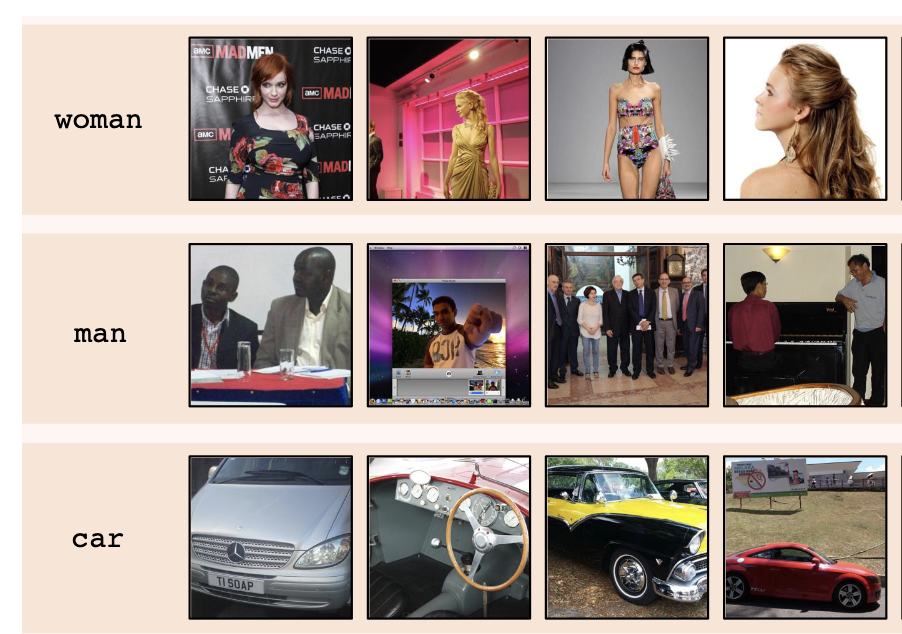
Researchers from USC, Columbia, Meta AI, and Rice University have developed a framework to track how gender biases embedded in popular pretrained computer vision models behave when those models are fine-tuned for specific downstream tasks — a question that has received surprisingly little systematic attention despite how widely these pretrained models are reused in industry and academia. The team built curated sets of reference images drawn from the COCO and OpenImages datasets, pairing everyday objects like surfboards and cars with images of men and women, and then measured how closely a model's internal feature representations clustered those object images with one gender versus the other, both before and after fine-tuning. Testing six off-the-shelf models — including ResNet variants, CLIP, MoCo, and SimCLR — across different architectures, training dataset sizes, and supervised versus self-supervised training regimes, the researchers found three notable patterns: models supervised on large-scale datasets like ImageNet-21k tended to carry their pretraining biases stubbornly into whatever new task they were fine-tuned on; fine-tuning on a larger target dataset like OpenImages was more likely to introduce fresh biased associations than fine-tuning on a smaller one like COCO; and self-supervised models, particularly MoCo, showed less bias retention than their supervised counterparts, though this was not universal. To quantify these dynamics, the team introduced a metric called the Bias Transfer Score, based on Spearman's rank correlation, which measures how much a model's bias-related associations shift between the pretraining and fine-tuning stages. The work is practically significant because many developers adopt pretrained models as black boxes without visibility into what societal biases they may be silently importing into their applications.
abstract
We introduce a framework to measure how biases change before and after fine-tuning a large scale visual recognition model for a downstream task. Deep learning models trained on increasing amounts of data are known to encode societal biases. Many computer vision systems today rely on models typically pretrained on large scale datasets. While bias mitigation techniques have been developed for tuning models for downstream tasks, it is currently unclear what are the effects of biases already encoded in a pretrained model. Our framework incorporates sets of canonical images representing individual and pairs of concepts to highlight changes in biases for an array of off-the-shelf pretrained models across model sizes, dataset sizes, and training objectives. Through our analyses, we find that (1) supervised models trained on datasets such as ImageNet-21k are more likely to retain their pretraining biases regardless of the target dataset compared to self-supervised models. We also find that (2) models finetuned on larger scale datasets are more likely to introduce new biased associations. Our results also suggest that (3) biases can transfer to finetuned models and the finetuning objective and dataset can impact the extent of transferred biases.
details
citation
@inproceedings{ranjit2023variation,
  title = {Variation of Gender Biases in Visual Recognition Models Before and After Finetuning},
  author = {Ranjit, Jaspreet and Wang, Tianlu and Ray, Baishakhi and Ordonez, Vicente},
  year = {2023},
  booktitle = {Workshop on Algorithmic Fairness through the Lens of Time at NeuRIPS 2023},
  url = {https://arxiv.org/abs/2303.07615},
}